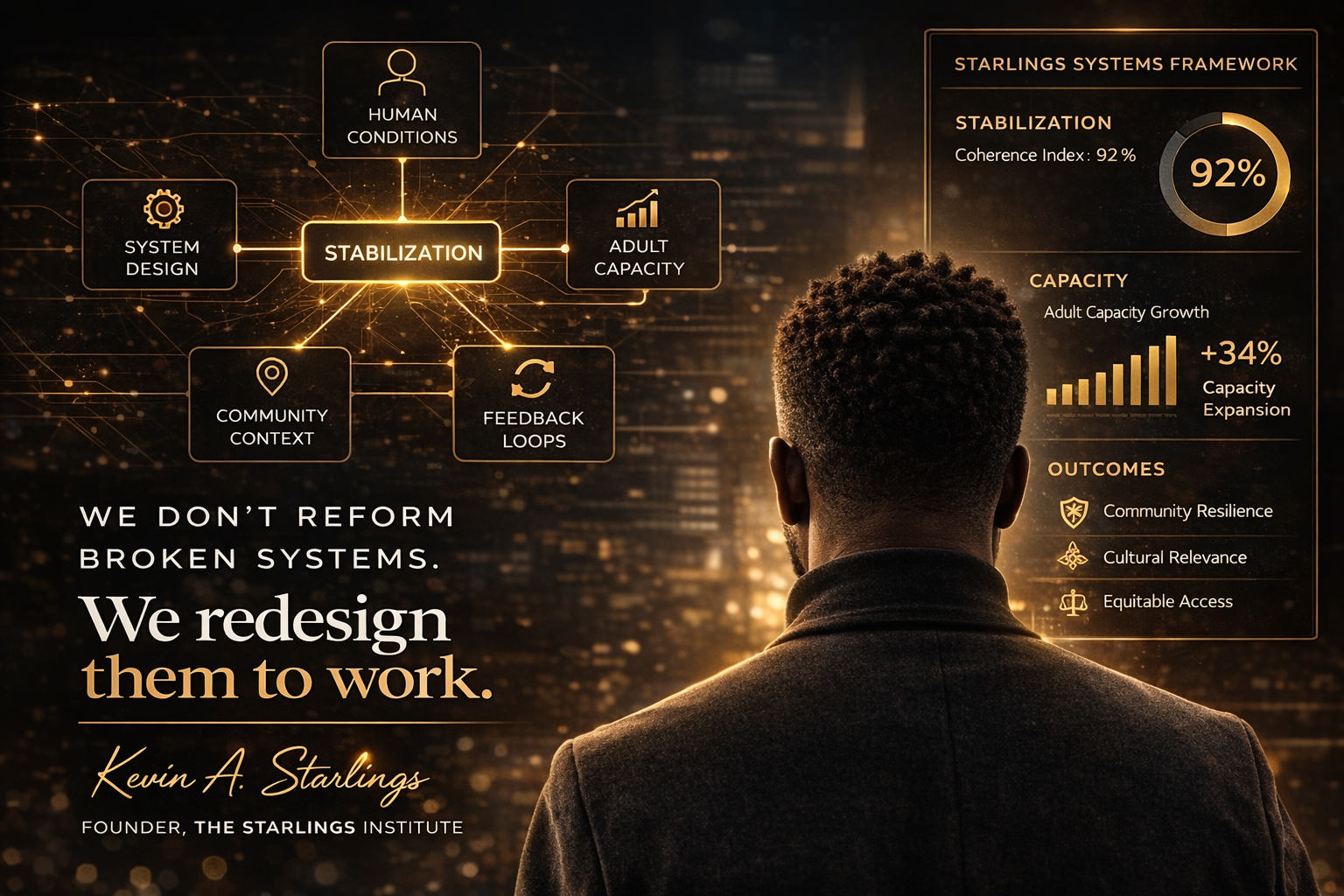
Human Systems Architecture

Defining How Systems Produce Outcomes

Systems do not fail randomly. Outcomes are not created through isolated action.

They emerge from the alignment or misalignment of conditions across systems. The Starlings Institute advances a new discipline focused on how human conditions, system structures, and environments interact to produce performance, stability, and long-term outcomes.
Performance becomes predictable when conditions are stable.
Outcomes Are Not Created. They Emerge.

Across systems, performance challenges are often treated as isolated failures.

In reality, they are the result of unstable and misaligned conditions.

When conditions align, systems stabilize.
When they fragment, performance declines.

This work defines how outcomes are produced—and how systems can be redesigned to produce stability.

Why Systems Fail to Sustain Performance

Across systems, performance breakdowns are driven by unstable conditions—not isolated failures.
01

Fragmentation

Explains how performance is regulated by environmental and systemic conditions.

02

Misalignment

Leadership, policy, and execution do not align across the system.
03

Overloaded Capacity

People operate beyond sustainable limits, reducing effectiveness over time.

04

Unstable Conditions

Environments lack the consistency required to support performance.
Human Systems Architecture
A developing discipline defining how system conditions produce outcomes. Outcomes are produced by the alignment of conditions across interdependent systems.

This is not a theory of improvement. It is a structure for understanding how systems actually function.

“We have focused on improving performance. We have not focused on designing the systems that produce it.”

Within this field, the Institute develops:
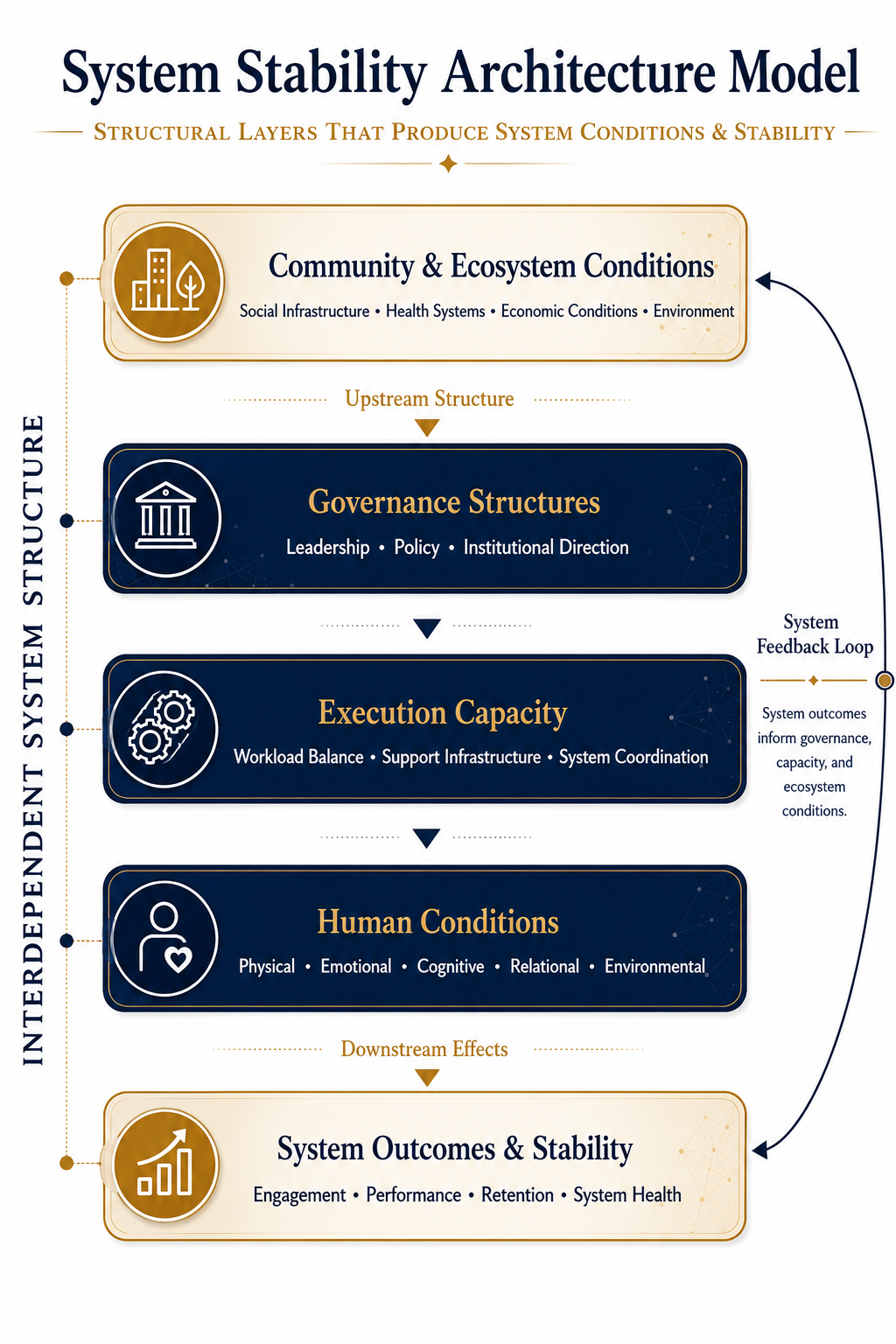
THE MODEL

Systems Stability Architecture

How Systems Actually Produce Outcomes

Performance is not driven by inputs.
It is produced by the stability of conditions across system layers.

When conditions align, systems stabilize. When they fragment, performance declines.
Outcomes are not created. They emerge.
When these layers are misaligned, systems fragment and performance becomes unstable.
This model defines how outcomes emerge from the alignment of interdependent system layers.

The Core Frameworks That Define the Field

These frameworks define how systems produce outcomes—and how they can be designed for stability.
01

Educational Architecture

Defines how system design shapes the conditions that produce learning outcomes.
02

Human Conditions Theory

Explains how performance is regulated by environmental and systemic conditions.
03

Distributed Conditions Model

Demonstrates how conditions across systems interact to produce outcomes.

Measurement Systems

04

Human Conditions Index (HCI)

Measures the stability of conditions that drive human performance.

05

Coherence Index (CI)

Assesses alignment across leadership, policy, and execution.

These tools make system conditions visible, measurable, and actionable.

From Research System-Level Change

This work translates insight into structured system redesign.
Research
0 0
Frameworks
0 0
System Design
0 0
Measurement
0 0
Implementation
0 0

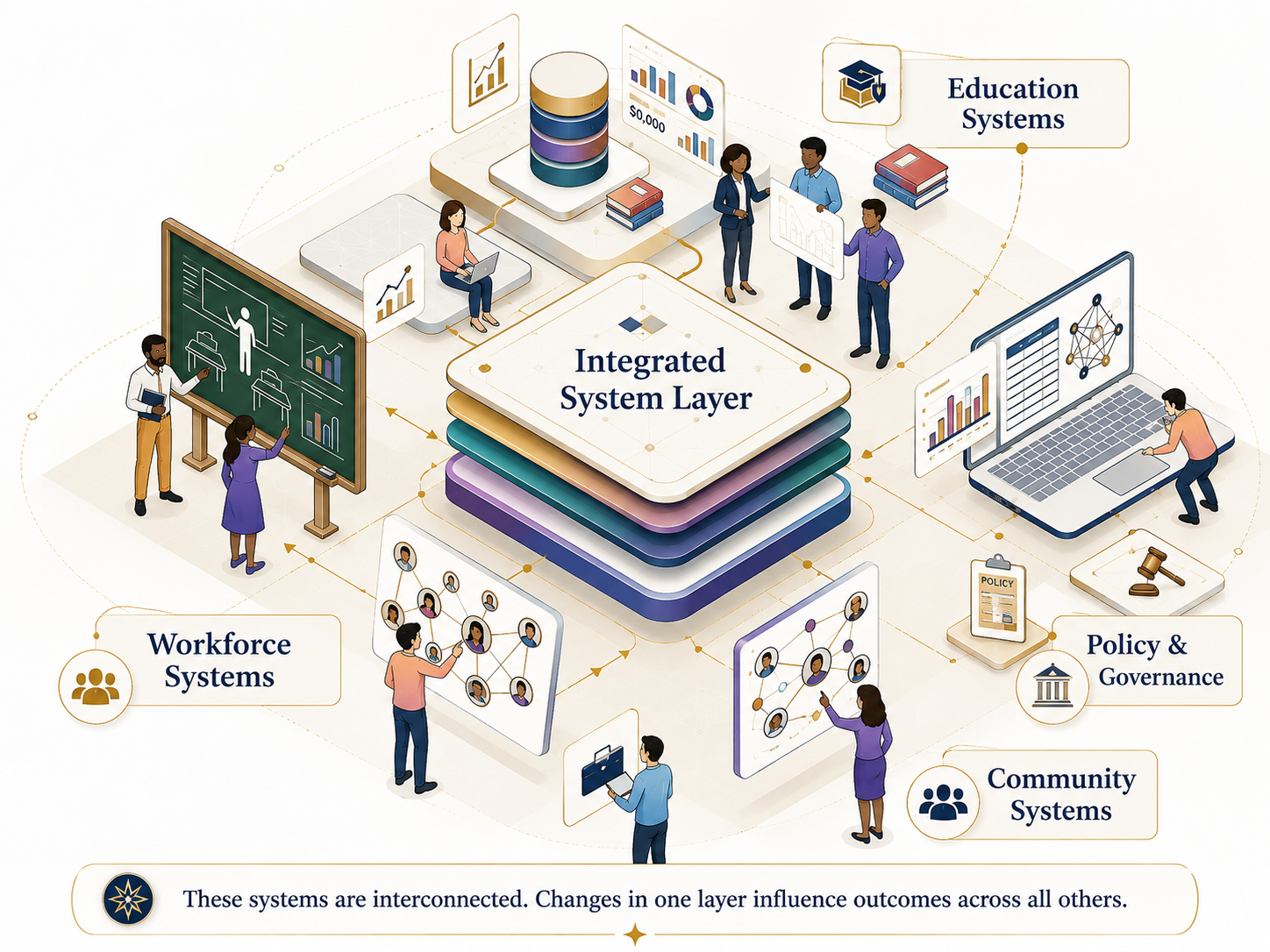
Where This Work Applies

Education
Systems
Stabilizing learning environments through structured system design
Workforce Systems
Aligning capacity, conditions, and organizational performance
Community Systems
Understanding how environmental conditions shape outcomes
Policy & Governance
Designing structures that produce coherent system behavior

These environments are not improved through isolated interventions.
They require structured frameworks that align conditions across systems.

A Structured Body of Work

The Institute’s research forms a coherent and expanding body of knowledge. Each publication contributes to a unified understanding of how systems function, how outcomes emerge, and how stability can be designed.

This is not a collection of ideas.
It is a system of knowledge.

This Is How Systems Are Understood. This Is How They Are Redesigned.
The Starlings Institute advances the study, design, and measurement of human-centered systems. By defining how conditions produce outcomes, this work provides a foundation for building systems that are stable, aligned, and capable of sustained performance.

Kevin A. Starlings

Founder of the Starlings Institute and originator of Educational Architecture, focused on the design of human-centered systems and the conditions that drive performance.

Access the Work

Engage with the research, frameworks, and models that define Human Systems Architecture.